XChat Launch Analysis: First 14-Hour Global Search Trends & User Behavior
A deep dive into XChat's viral growth in Asia and Eastern Europe versus its silent launch in the US. Real-time data from Google Trends and Clarity.
XChat Launch Analysis: First 14-Hour Global Search Trends & User Behavior
XChat's first measurable global burst was short. Just 14 hours. But the pattern is already clear.
This is not a uniform launch. It is a split-screen launch.
One screen shows high-intensity demand across parts of Asia, Eastern Europe, and frontier mobile markets. The other shows a quieter, lower-urgency profile in the US and UK app-intent channel.
That gap matters. It suggests XChat is not merely trending as a social product. It is being evaluated as infrastructure.
The early signal is geopolitical before it is demographic: XChat adoption intent is strongest where trust in communication layers is treated as a strategic question.
The map signal: a global product with regional heat extremes
From geoMap.csv (2026/04/24 21:12 to 2026/04/25 21:12), Google Trends split search interest between xchat and xchat APP by country/region. The headline values are below.
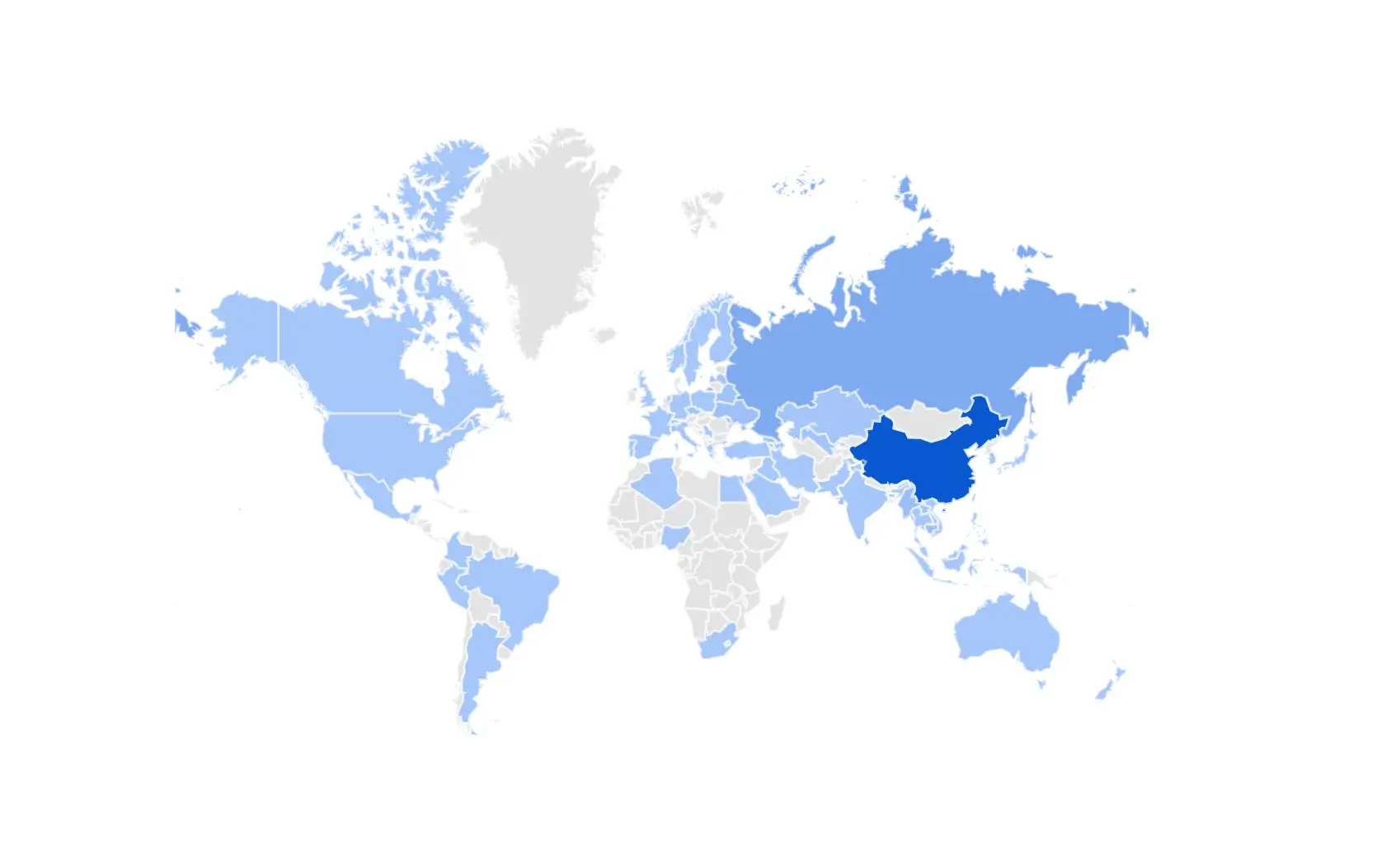
| Region | XChat share | XChat APP share |
|---|---|---|
| China | 96% | 4% |
| Russia | 85% | 15% |
| Hong Kong | 93% | 7% |
| Taiwan | 94% | 6% |
| Macau | 100% | - |
| Myanmar | 100% | - |
| Cambodia | 100% | - |
| United Kingdom | 90% | 10% |
| United States | 87% | 13% |
These numbers need context. They do not mean US/UK users ignored XChat. They mean the composition of intent differs.
In China, Hong Kong, Taiwan, and several Southeast Asian markets, search behavior concentrates around the core XChat concept itself. In the US/UK lane, xchat APP keeps a larger share. That often indicates a more store-led, product-category style discovery path.
Short version:
- High-heat regions: direct concept pull.
- US/UK: lower-friction, slower app-intent framing.
This is the "digital temperature" effect. People do not search communication tools the same way everywhere.
When privacy risk is perceived as immediate, users search for the protocol promise first and the app store object second.
At roughly one-third into this analysis, one operational takeaway is straightforward: onboarding clarity must be visible early. The current traffic pattern validates investment in practical guides such as How to Use XChat.
Search intent is not vague: download, legitimacy, and compatibility
Query data across xchat_relatedQueries (2).csv and xchat_APP_relatedQueries.csv shows three high-conviction intent clusters.
1) Android acquisition intent is explicit and multilingual
Global TOP queries include:
xchat скачать(31)xchat android(23)xchat 安卓(9)xchat apk(6)xchat 注册(6)
Global RISING adds acceleration:
xchat 注册(+140%)xchat скачать(+90%)xchat apk(+60%)xchat 安卓(+60%)
This is not passive search curiosity. It is installation-and-activation behavior.
Users want:
- A safe download path.
- Device compatibility clarity.
- Fast registration answers.
That explains why guide pages overperform relative to generic blog-style landing content during launch windows.
2) Elon Musk is functioning as a verification token
In APP-related queries:
- TOP:
xchat илон маск(21),xchat илон маск app store(21),xchat elon musk(10),xchat elon musk app(10) - RISING:
xchat илон маск(+350%),xchat илон маск app store(Breakout)
In plain terms, users are using Musk-linked keywords to answer one high-value question: "Is this the real one?"
That has two strategic implications:
- Brand-adjacent trust language directly affects conversion quality.
- Store listing consistency and authenticity markers are not cosmetic. They are acquisition infrastructure.
3) iOS 26 compatibility appears early as a decision gate
From global RISING queries:
ios 26(Breakout)
This matters because compatibility anxiety appears before feature-depth questions. For many users, the decision tree is simple:
- Will it run on my current OS?
- Is this the official app?
- Can I install and register quickly?
Only after those three are solved does deeper retention logic begin.
In early-stage communication app launches, compatibility certainty is conversion velocity.
Clarity behavior data: curiosity is measurable, not anecdotal
Clarity_homepage_Dashboard_04-25-2026 08 42 PM.csv provides in-product behavior from 04/23 to 04/25.
Core values:
- Total sessions: 68
- Unique users: 49
- Average pages/session: 2.88
- Dead click sessions: 12 (17.65%)
- Quick back click sessions: 5 (7.35%)
The 17.65% dead-click rate is the critical metric.
Dead clicks are not always a bug. In launch contexts, they often indicate probing behavior. Users are exploring affordances, guessing where interactions should be, and testing UI mental models.
Top pages confirm that pattern:
| Top page | Sessions |
|---|---|
/en |
21 |
/en/guide/how-to-use-xchat |
13 |
/en/guide |
10 |
/en/compare |
9 |
/en/compare/xchat-vs-whatsapp-vs-signal-vs-session-authority-guide |
8 |
/en/guide/xchat-android |
7 |
/en/guide/xchat-login-register |
5 |
Interpretation:
- Users are moving from homepage to task-specific education.
- Security comparison pages rank high very early.
- Android and login/register content are practical conversion assets, not support leftovers.
This is exactly what you would expect from a product being evaluated as a serious messaging migration candidate.
Why E2EE framing over-indexes in hot regions
The protocol narrative is short. That is its power.
XChat's E2EE framing promises message-level confidentiality with lower dependence on intermediary trust. In high-heat markets, this message is legible in one sentence and actionable in one minute.
Compared with mainstream chat app discovery in lower-friction regions, hot-region users often optimize for three conditions first:
- Can third parties inspect message content at scale?
- Is account setup straightforward enough for non-technical contacts?
- Is migration possible without abandoning existing channels immediately?
E2EE does not solve everything. Metadata and network-level exposure remain discussion points for any modern messenger.
But launch data suggests the market is rewarding clarity of security posture now, not later.
The strongest early growth driver is not novelty. It is a credible minimum privacy guarantee presented in operational language.
From chat app to "Everything App" foothold
XChat should be read as the first block in a broader stack, not the final product layer.
The pattern across geodata, search intent, and behavior analytics points to a familiar scaling path:
- Phase 1: trust-sensitive messaging adoption.
- Phase 2: utility workflows around identity, prompts, and lightweight transactions.
- Phase 3: deeper service convergence once daily active trust is established.
That is why these first 14-hour signals matter. They show where trust formation is cheapest and fastest. They also show where product messaging must remain concrete.
No abstraction. No vague "future platform" language.
The audience is telling us exactly what it wants right now:
- Download certainty.
- Official-source certainty.
- Version certainty.
- Privacy certainty.
Teams that satisfy these four conditions first usually win the next layer of product expansion.
Unlock XChat Potential
The next conversion step is capability, not awareness.
Use the Grok Prompts library to move from basic messaging to structured, repeatable workflows inside XChat. For global users arriving with high trust sensitivity and high task urgency, prompt quality can become the retention multiplier after install.
Grok Output Analysis Loading...
Real screenshot coming soon
Get Started with XChat
Download XChat on iOS and start private, encrypted conversations today.
Download on the App Store →